Wednesday, March 26 · La Lata Peinada · 7 PM

Research prototype · Computer vision

Yet, The Faces. Lab is a research prototype developed by Artefacto during the production process of the feature-length documentary Yet, The Faces. The film articulates its research around prosopagnosia, a neurological condition that affects the ability to recognize identities through faces. Those who experience it perceive facial features clearly, but identity recognition fails even with people in their immediate environment. This condition forms the dramatic and conceptual core of the film, which observes it in parallel to the sustained growth of biometric identification systems deployed on a global scale. The coincidence between both phenomena opens the central question of the project: how facial recognition algorithms operate and what relationship they hold with human processes of perception and identity.

The prototype functions as a web interface that allows uploading images or activating the camera in real-time to execute different computer vision models on faces within a scene. The system integrates seven detection models and four recognition models from open-source research in computer vision.
Among the detectors are YuNet, MTCNN, MediaPipe, InsightFace SCRFD, YOLOv10-Face, and RetinaFace, each with different architectures, speeds, and training conditions. Recognition models include ArcFace, FaceNet, SFace, and DeepFace, all based on deep convolutional neural networks.
The detection process locates faces in the image by identifying facial patterns at different scales and lighting conditions. Next, the recognition models generate facial embeddings—that is, vector representations in high-dimensional spaces (128 or 512 dimensions depending on the model)—that allow calculating similarities between identities through mathematical distances.
The tool allows executing several models on the same image simultaneously to observe how each architecture detects faces, generates framing, and produces different representations of the same person.

The project situates these technologies within a field of questions about identity, memory, privacy, and accessibility. Facial recognition systems are part of infrastructures of surveillance, migration control, and urban security whose expansion generates active debates regarding digital rights and personal data protection. Yet, The Faces. Lab addresses these technologies from an additional angle: the possibility that a system capable of detecting and associating faces functions as a cognitive support tool for people with prosopagnosia. This reorientation of use shifts the technical device from the registry of control toward that of assistance, without ignoring the tensions that the same device carries in other contexts.
The development of the prototype was carried out in dialogue with computer vision researchers, a neurologist specialized in visual perception, a philosopher working on technology and subjectivity, a digital rights activist, and the film’s director.

The application also incorporates an anonymization module that allows modifying detected faces through blurring, pixelation, hiding, or substitution with graphic elements. This function opens a line of work on visual protection strategies in audiovisual materials and on the relationship between representation and anonymity.
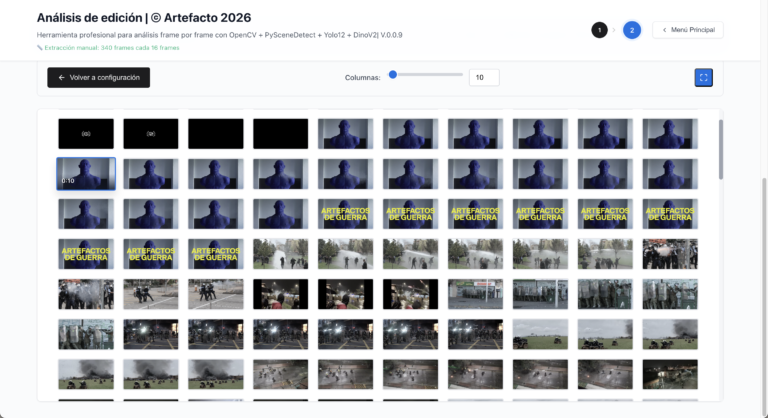
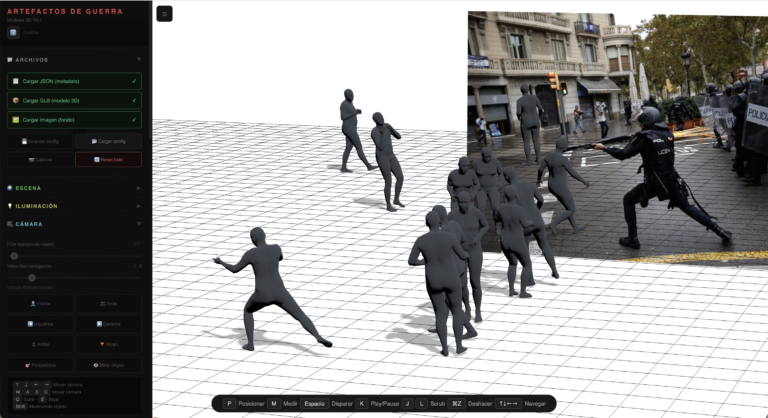
Yet, The Faces. Lab is part of Artefacto’s work model, which develops technological prototypes in parallel with its cinematographic processes. The laboratory functions as an environment where technical research and narrative research feed back into each other; the analysis of how algorithms function informs the film’s gaze, and the questions opened by filming guide the development of the tools.
Code and documentation:
https://github.com/jcaballeroramos/yetthefaces