Forensic 3D viewer for the analysis of non-lethal weapons use in social protests.
Artefactos de guerra is a feature-length documentary examining the global market for so-called «non-lethal» weapons—tear gas, foam projectiles, tasers, water cannons—through observational recording at European arms fairs and an archive that traces the continuity between their design and their victims. Alongside that film exists a second part of the project, technical and operational: an open-source forensic algorithm and a 3D viewer that allows for reconstructing repression scenes, simulating ballistic trajectories, and measuring distances in the reconstructed space. This description is about that system.
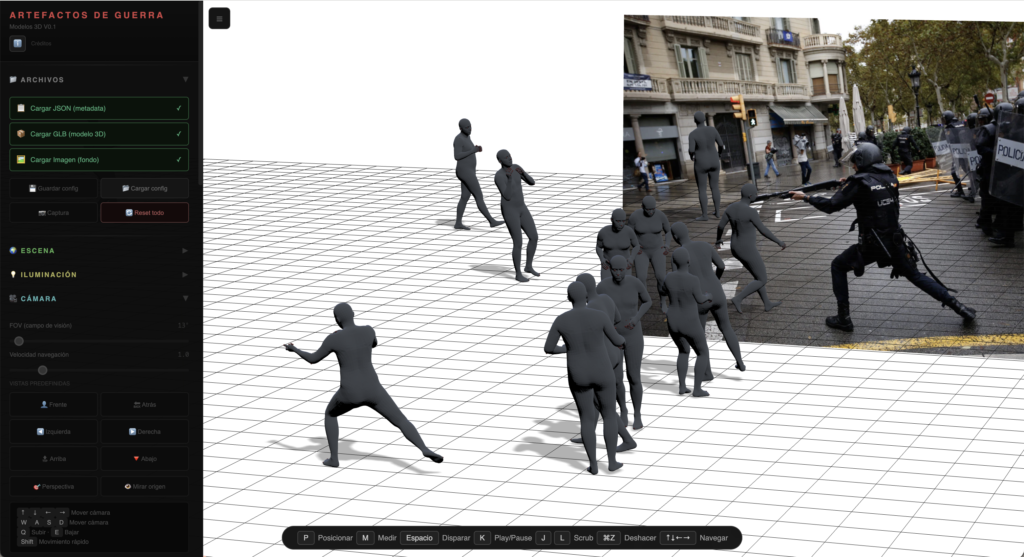
Given a photographically documented incident, is it possible to demonstrate that the projectile could not have reached that person from that angle, at that distance, with that weapon, if use-of-force protocols had been respected? That question has criminal and political consequences in the cases the project works on directly—victims of foam in Catalonia, the wounded from the Chilean social uprising, among others—and cannot be answered with conventional image analysis. It requires extracting three-dimensional body positions from the photographic plane, anchoring the projectile’s physical parameters onto them, and simulating. The viewer is the interface for that process.
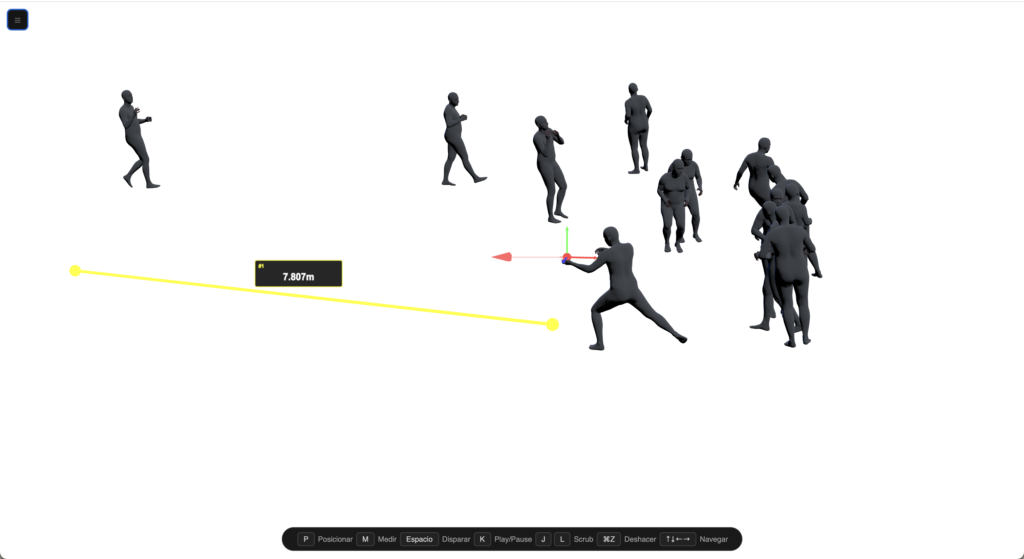
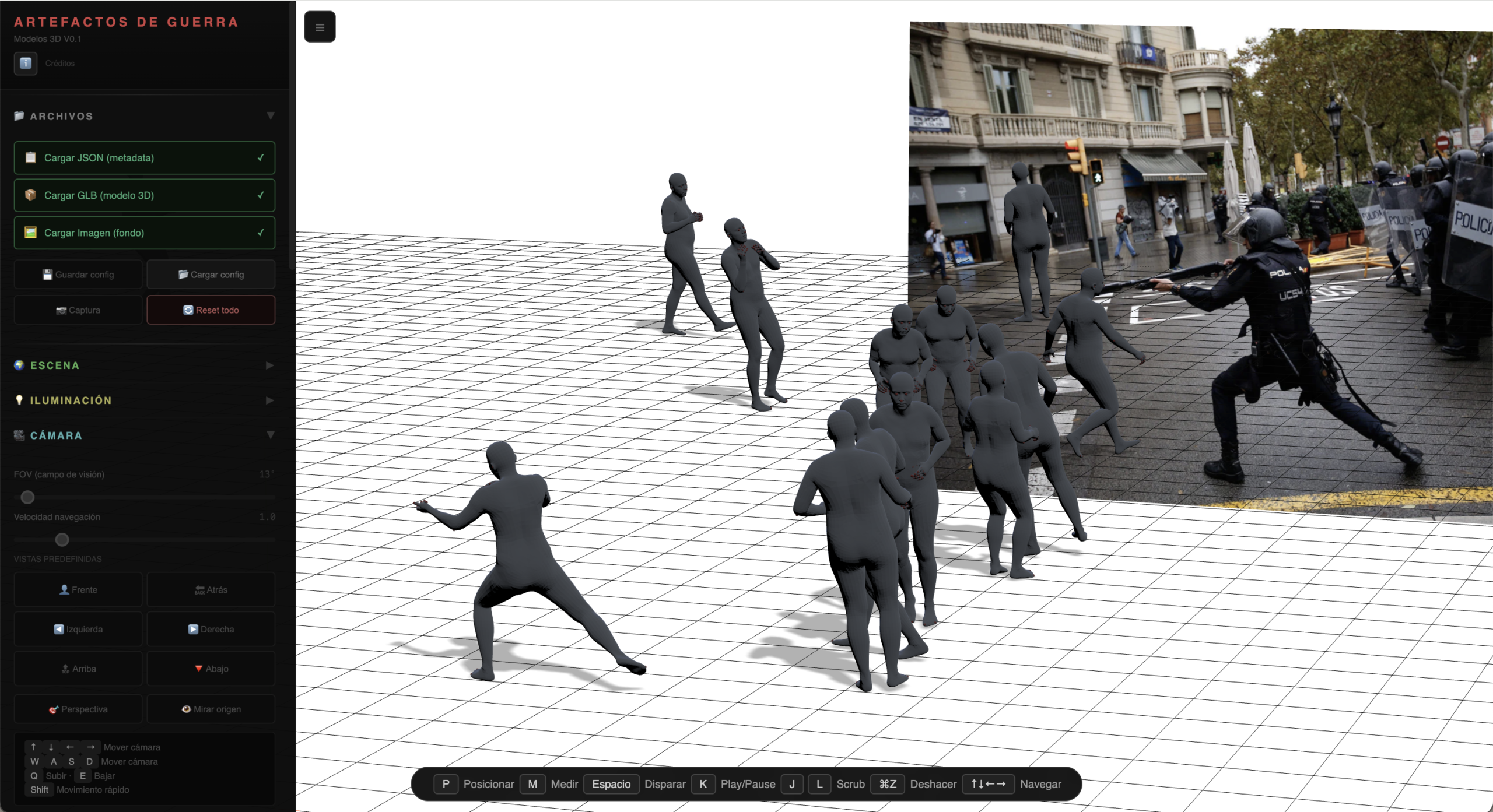
The system works in three articulated layers. The first is the 3D reconstruction of bodies from a photograph of the scene: a pose estimation model based on SAM 3D extracts 70 keypoints in three dimensions for each person detected, the estimated focal length of the camera, and the position and orientation in space. That dataset is exported as metadata JSON and as a GLB mesh (the binary format of glTF, a 3D real-time standard) and loaded into the viewer. The second layer is the ballistic simulation engine, built on Three.js, which allows selecting the type of projectile by category—for example, 40mm launched, hand-thrown, caliber 1—and by specific ammunition model, from the 7290M Mini-Bang to the 5230B Sting-Ball CS or the 6210 tear gas; configuring firing force, gravity, size, and simulation speed; and defining the origin of the shot in X, Y, Z coordinates of the reconstructed space with angles. The third layer is the spatial measurement system: the measurement mode allows placing points in three-dimensional space, dragging them with live distance visualization, and exporting measurements with their components on each axis.
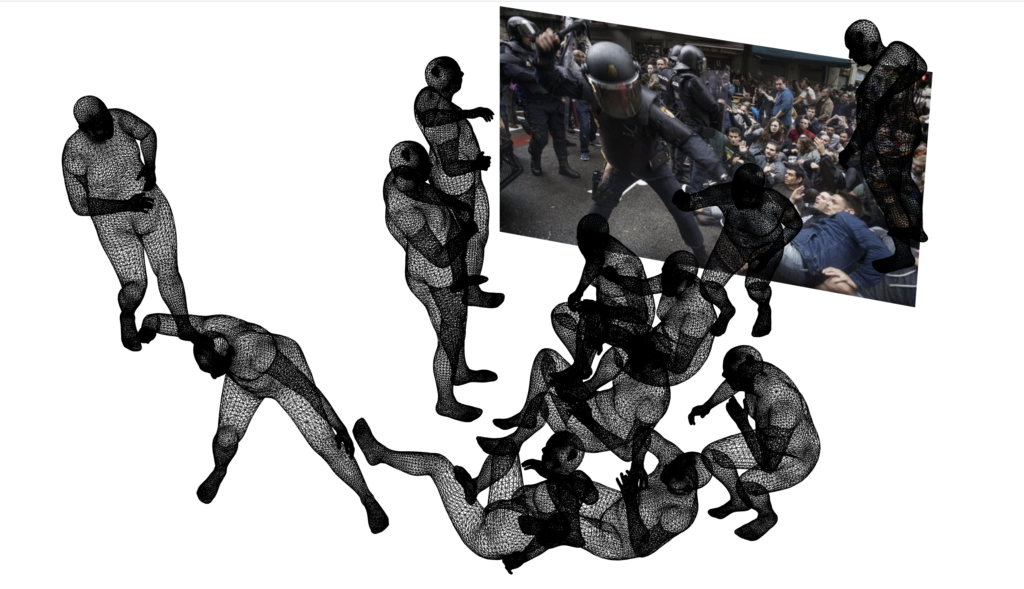
The complete configuration of each analysis—body positions, firing origin, ballistic parameters, measurements—can be saved and reloaded in JSON for reproducibility and collaborative work.
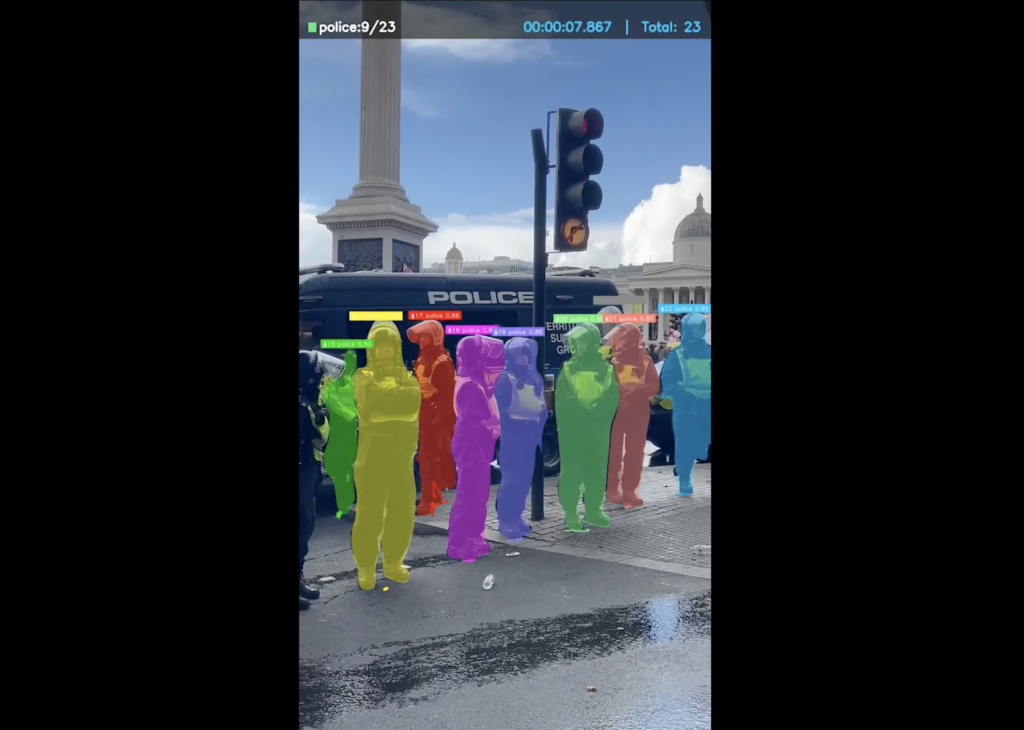
The project is part of the tradition of what Forensic Architecture calls «spatial investigation»: the use of methods from architecture, engineering, and computer graphics to produce evidence about events that the State has an interest in obscuring. The specific difference of this system compared to standard forensic reconstruction methods—which usually require LiDAR scanners, calibrated cameras, or access to physical space—is that it operates exclusively from available photographic images, many taken by journalists, protesters, or witnesses.
The tool is being used to reconstruct specific cases of foam projectile use. The application, in its current version (V0.1), already allows loading the scene photograph, importing the 3D mesh generated by the pose algorithm, simulating the projectile’s trajectory over the reconstructed bodies, and exporting the analysis measurements. The goal formulated as a thesis is that a sufficiently precise three-dimensional reconstruction can turn an image into a legal argument, demonstrating not only that someone was injured, but under what physical conditions and under which protocol that was possible or impossible.