Screenings turns each viewer’s phone into an audience measurement instrument. During a projection, the whole room stays synchronised with the screen and every person reacts by swiping, without taking their eyes off the film. The result is the audience’s attention recorded minute by minute over the footage, instead of the overall score of an exit form.
It works for any audiovisual piece and any situation where you want to know what happens to a room while it watches, from work-in-progress screenings and rough cuts to focus groups, audience sessions at festivals or classrooms. Where there used to be a general impression, there is now a curve.
The team opens the screening from the projector, the screen that plays the video and sets the time for the whole room. Viewers join by scanning a QR code with their phone, with no sign-up and no download, and from that moment their clock obeys the projection, starting on play, freezing on pause and ending when the screening closes.

The projector, with the protected video, the entry QR and the connected viewers, live.
In the hand, the interface is designed for a dark room, with black surfaces and no flashes, and the only response to a gesture is a border that lights up for an instant. Swiping right records that the film is holding, left that it is losing, and swiping up opens a written note. Every gesture stores the exact second of the footage at which it happened.

The viewer screen, designed not to light up the room.
The panel draws the reaction curve over the footage and turns it into editing insight. It flags the stretches that fall below the attention threshold, with their timecode and average. It collects the written notes, which tend to explain the why behind each drop. And it can segment the curve by viewer profile, age, occupation or education, to tell whether the second act is losing the whole room or only part of it.
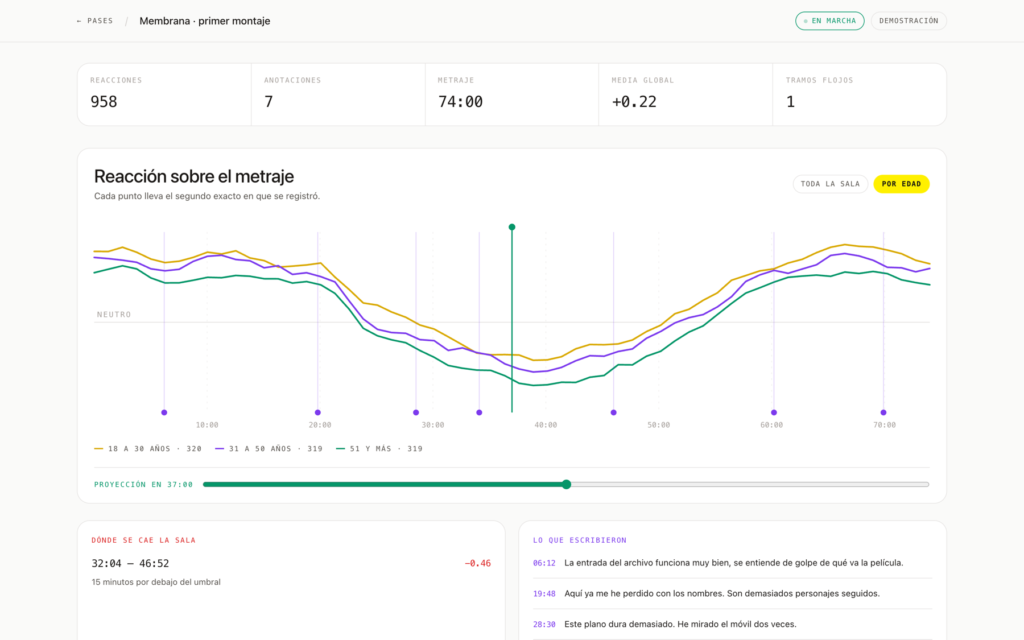
The reaction curve over the footage, segmented by age group.

The screenings panel, with each projection and its curve in miniature.
A web application with a Node server and MongoDB behind it. Synchronisation runs on server-sent events, so the projector broadcasts its position every second and every device shares the same timeline. Videos are served through protected links that expire after twenty-four hours, made for unreleased material. The first version was built in 2023 with developer Andrey Nikushkin, and in 2026 we rewrote it from scratch in the house’s current visual language and put it back into production.
The public demo walks through a complete screening with demonstration data. The production panel is restricted.