Artefacto · Cine Español is a research platform developed by Artefacto Films. It brings together, in a single interface, the public data on Spanish films released between 2016 and 2025 and turns it into interactive visualisations that answer concrete questions about the industry. Who works with whom. What films are really about. How their posters look. What the Goya awards reward. How much public money each project receives and from which programme.
The starting point is a simple observation. The data exists and is public, but it lives scattered across official bulletins, institutional catalogues and technical-record portals. The platform gathers it, cleans it and makes it searchable in seconds.
The corpus brings together 1,652 films and nearly 4,700 people indexed across 13 different crafts. The main sources are these.
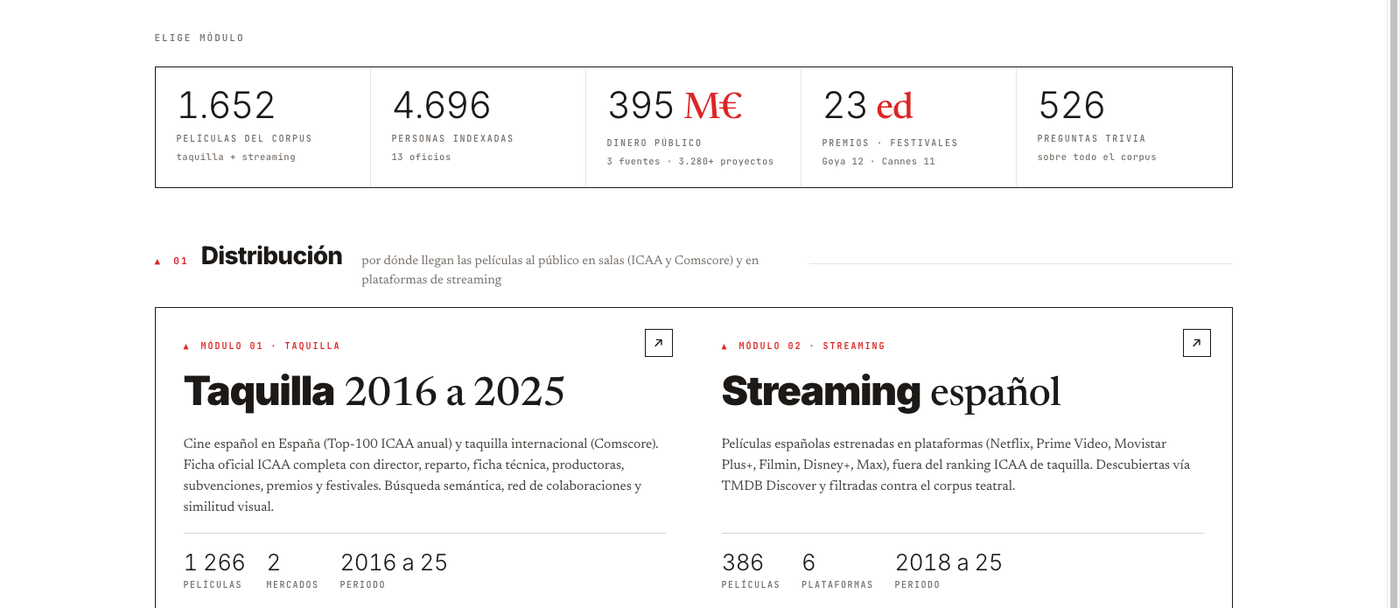
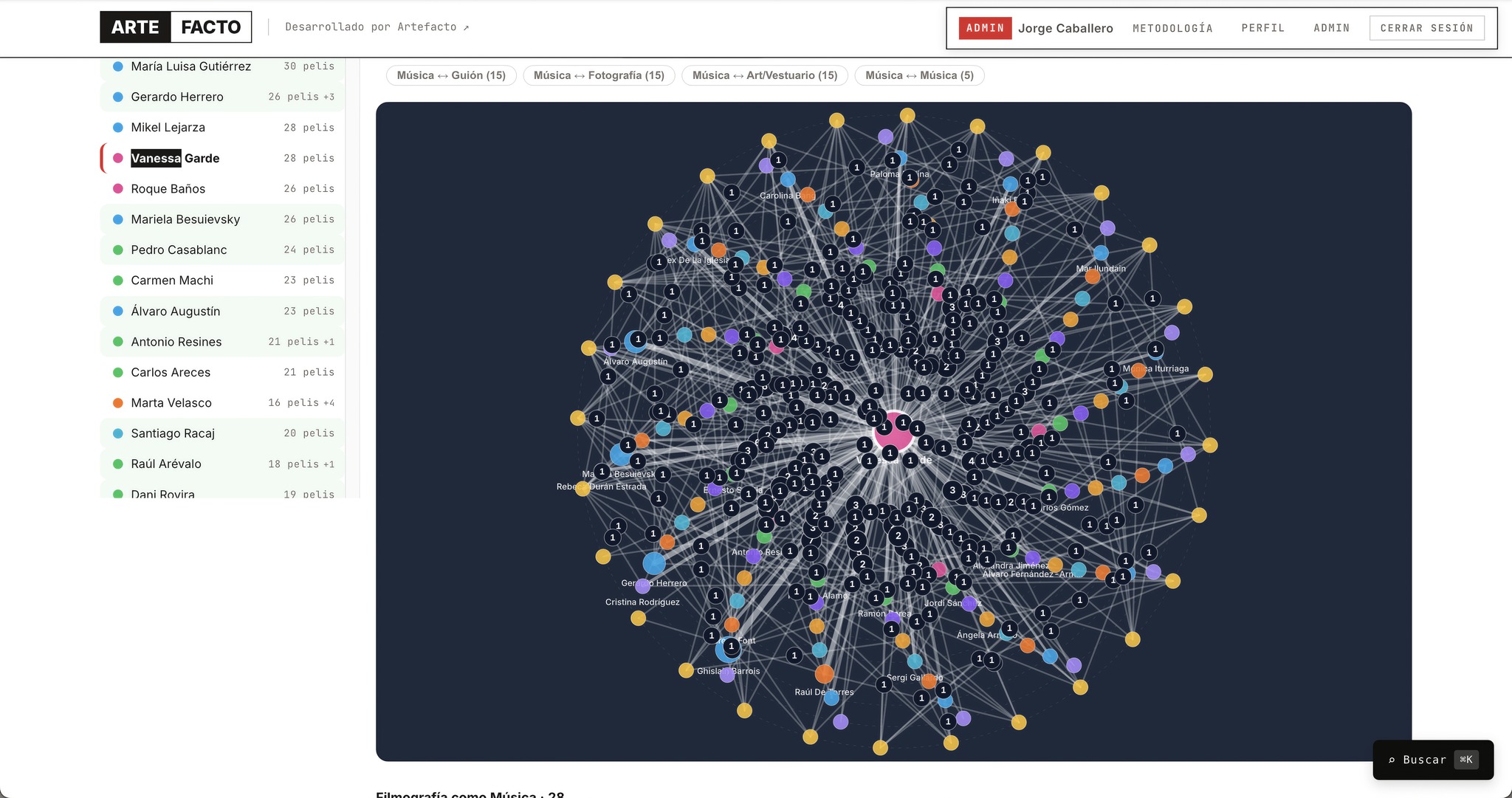
Explore the box office. Tables and charts with filters by year, genre, market or platform, and a collaboration network that draws the graph of the people who have worked together, with more than 4,600 collaborations detected.
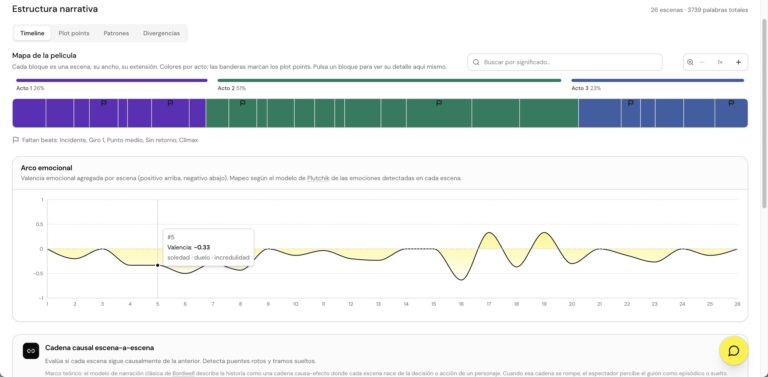
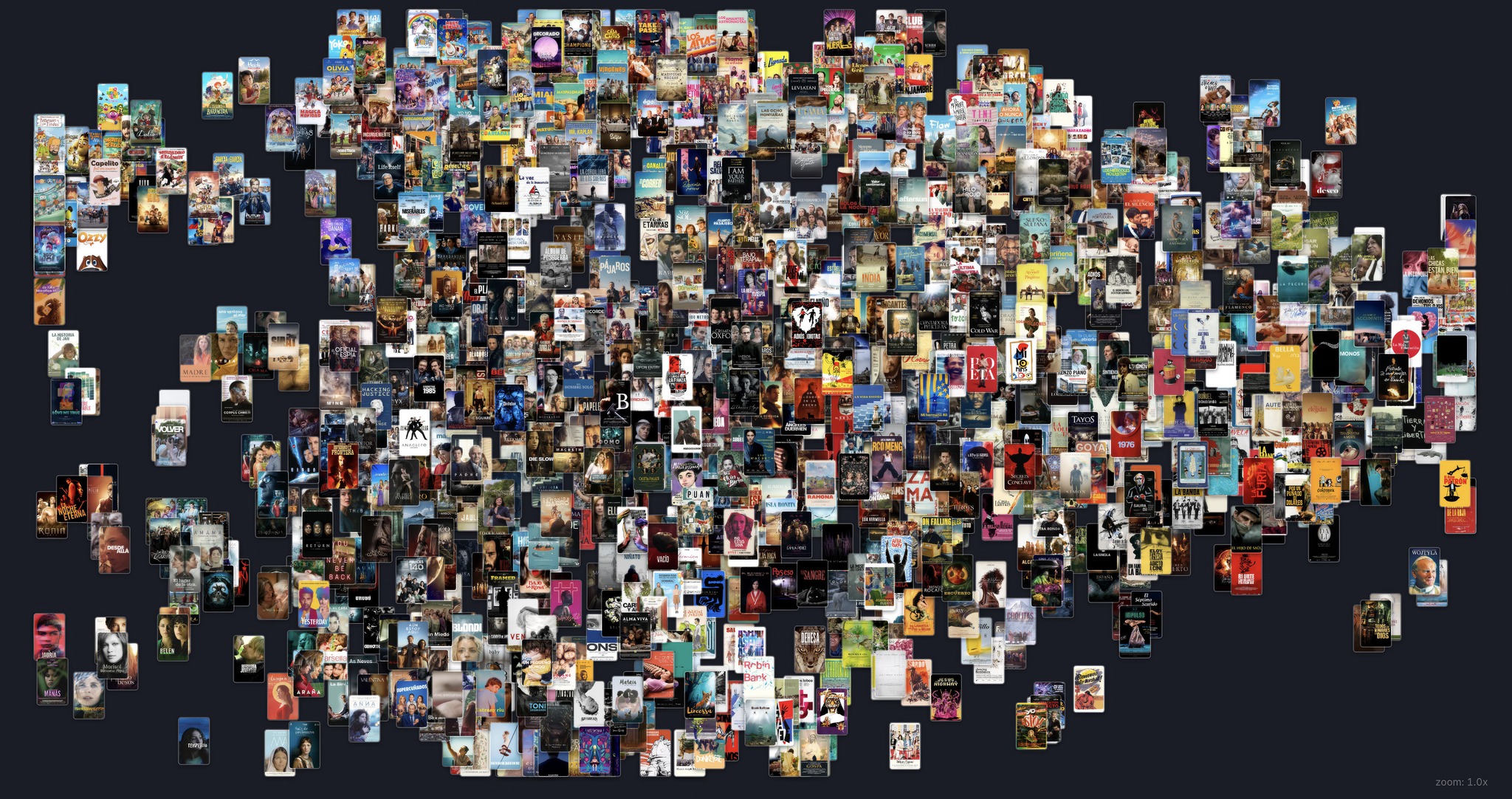
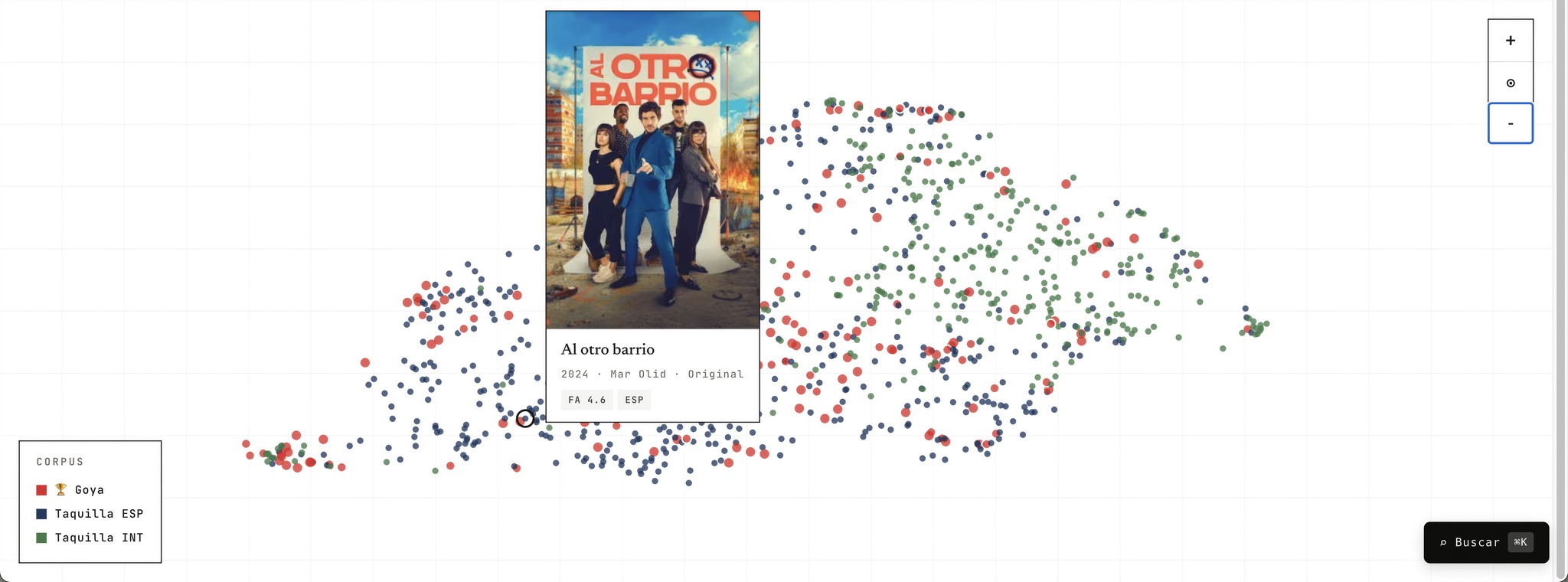
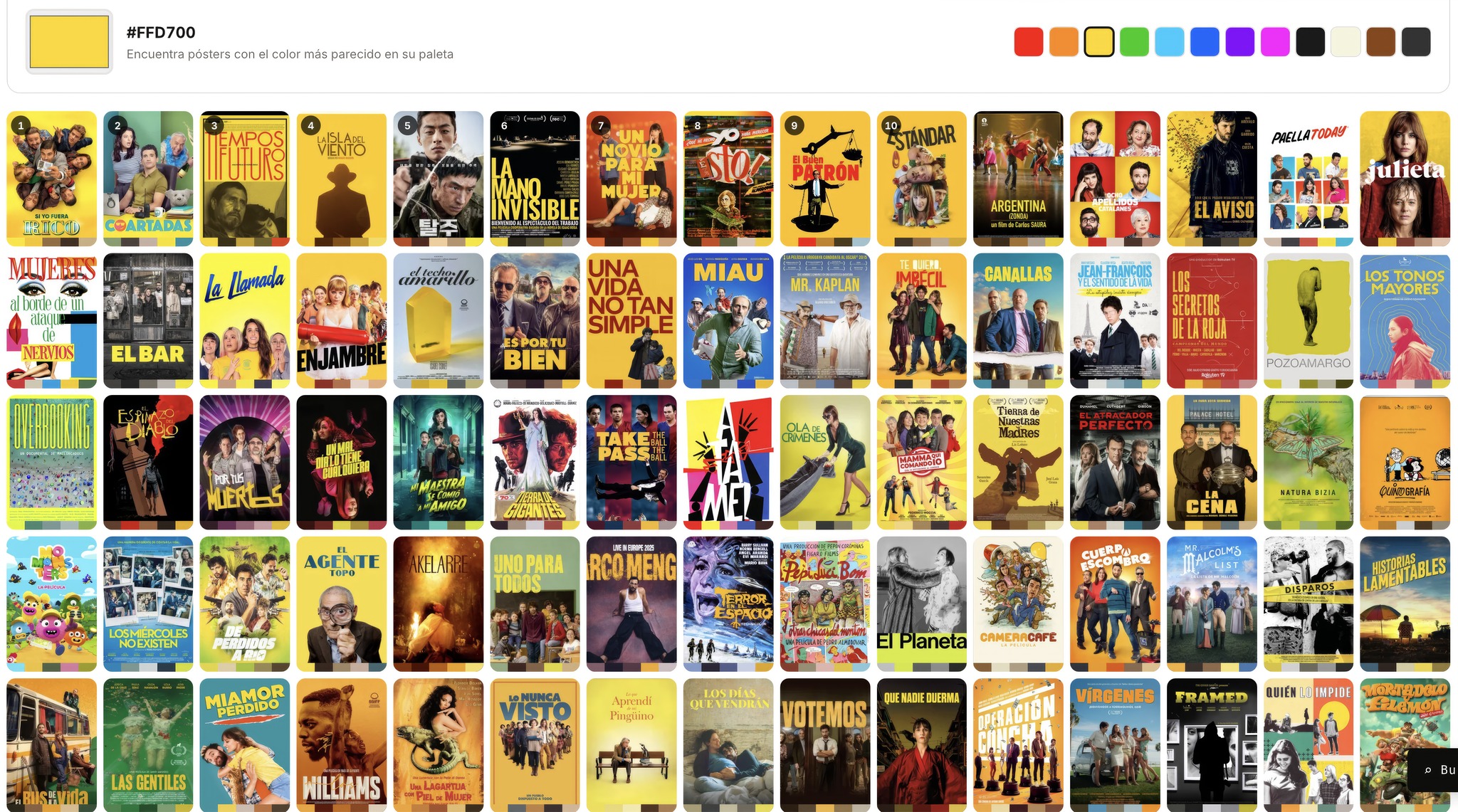
See cinema as a map. More than 1,400 posters arranged on a two-dimensional plane where closeness means resemblance. There are two complementary maps. In one, films are grouped by their narrative DNA, computed from their synopses. In the other, posters are grouped by visual resemblance, and can also be searched by dominant colour.
Ask in natural language. The “What is it like?” feature accepts an invented synopsis or an idea written in free text and returns the most akin films in the corpus, with an explanation of how each one resembles it.
Read the depths of the corpus. A findings section synthesises aggregate patterns, such as the narrative archetypes of the form “an X who Y” extracted from each synopsis. The most frequent of the decade turns out to be the intimate portrait of an art or culture figure, with more than a hundred films.
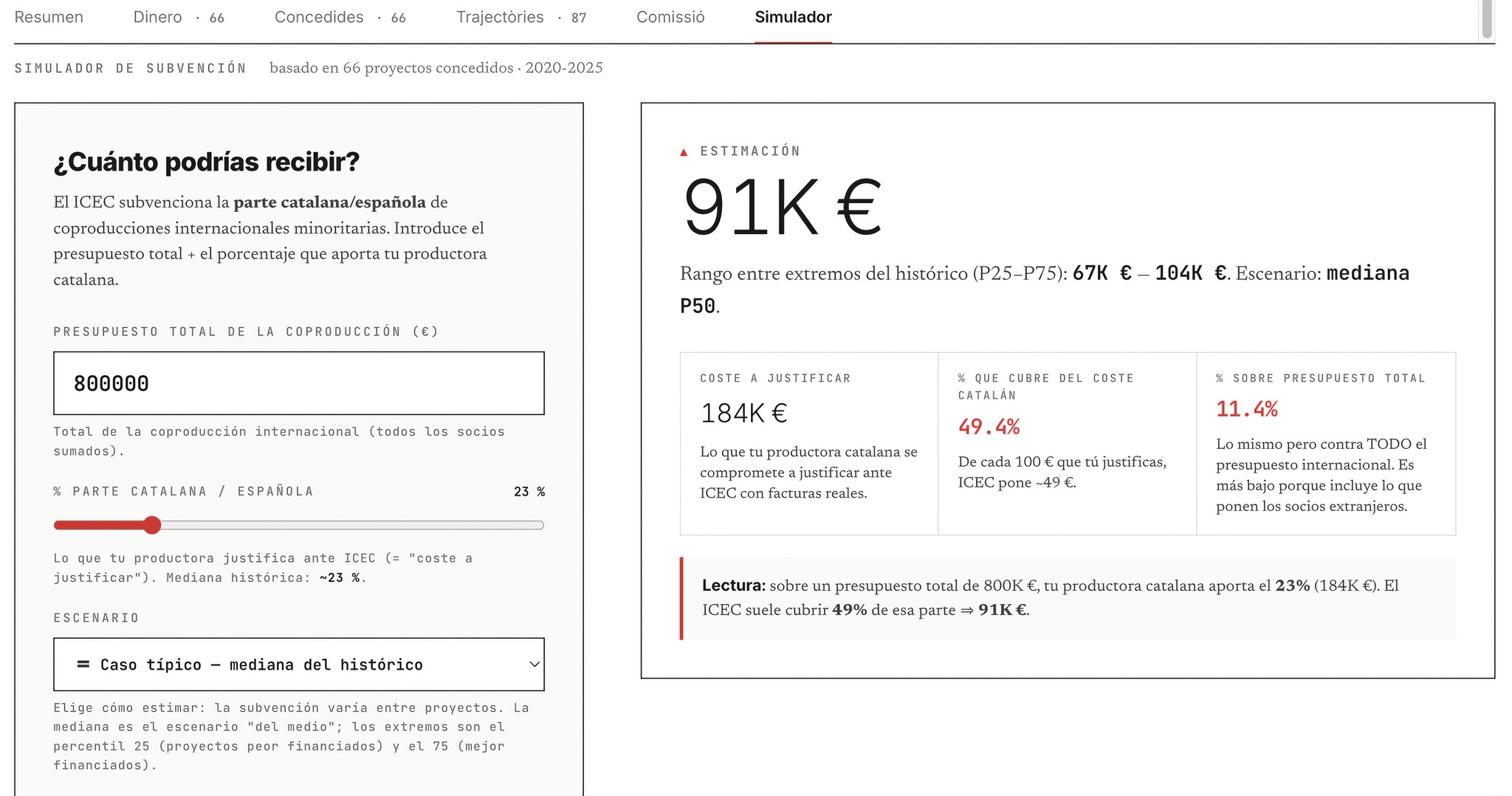
Estimate a public grant. A simulator computes the likely amount of a subsidy based on the project’s budget, using the real historical distribution of each programme.
Browse individual records. Every person and every film has its own record, with filmography, awards, grants received, availability platforms and similar films.
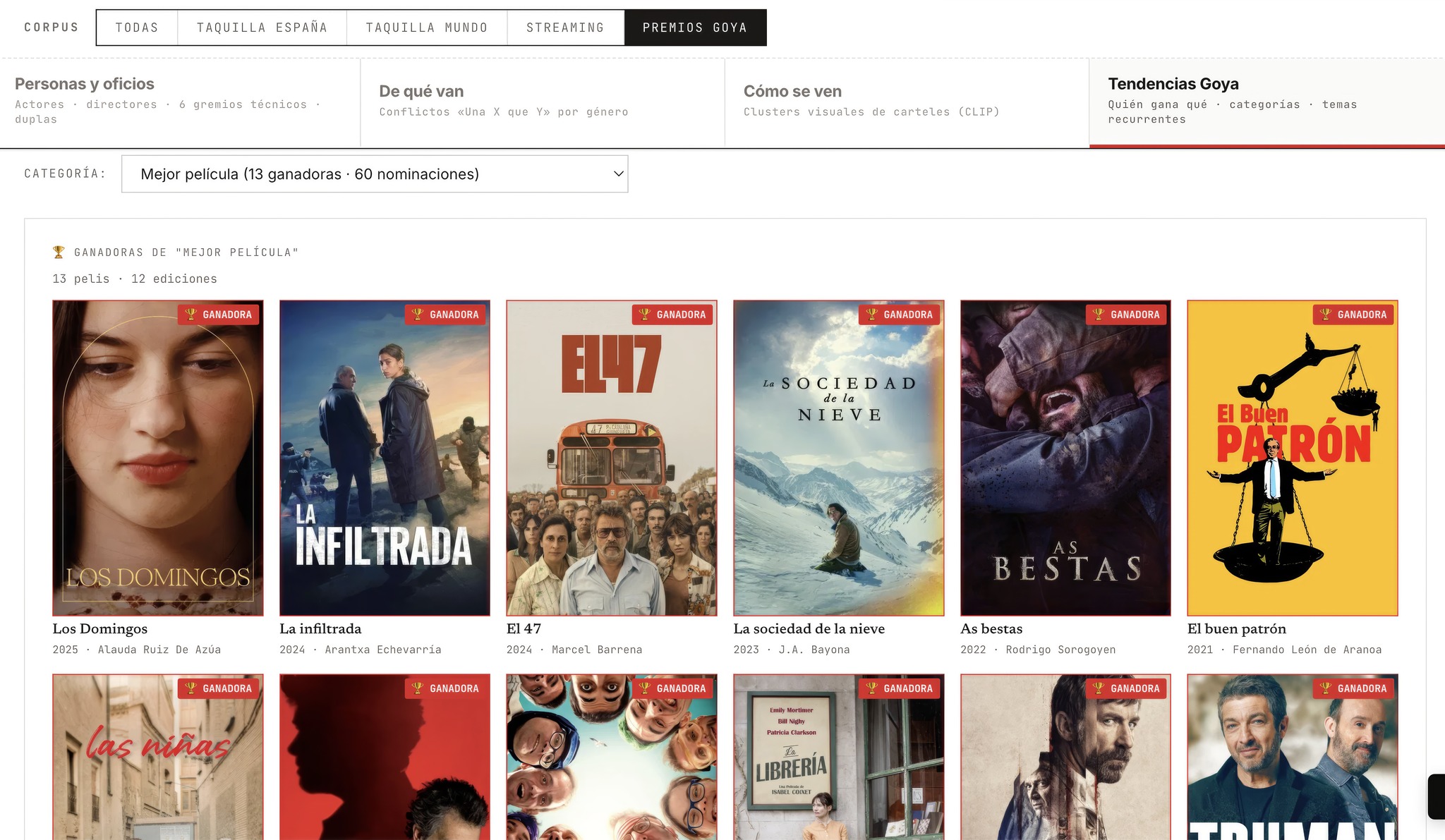
There is also a trivia game of 526 questions generated from the whole corpus.
The platform is designed to be fast and easy to maintain. Almost all the information is worked out in advance and stored in lightweight files, so the site loads instantly and runs on very few resources. A small server handles the user accounts and connects to the computational models securely, keeping the access keys away from the browser at all times.
The result is a site that is fast and very cheap to run, because the paid computational models only come into play in the two features that genuinely need them.
The computational models intervene at two distinct moments of the project.
The first is building the corpus, a pipeline of more than a hundred Python scripts that runs outside the website. Several language models helped order and cross-check the already-published information: Claude Haiku 4.5 structured and normalised the scattered catalogue fields, Claude Opus reconstructed the data the official sources left incomplete, and Gemini 2.5 Flash classified the posters’ graphic motifs through visual analysis. Each synopsis was turned into a numeric vector with Gemini Embedding 2 (3,072 dimensions reduced to 192 via PCA) and each poster was processed with CLIP, OpenAI’s vision model. The positions on the maps come from projecting those vectors into two dimensions with UMAP. That two films end up close together is not an editorial decision. It is geometry over their contents.
The second moment is live use. The “What is it like?” search vectorises the user’s text with Gemini, compares it against the whole corpus and asks Claude Sonnet 4 to rank the candidates and justify each choice. The conversational analysis lets you interrogate the data with the corpus loaded in context. Both features consume paid API credit, which is why they are reserved for authorised accounts.
Access requires registration. Each person signs in with their Google account, which already arrives with the email verified, and every new account stays pending until an administrator approves it from the management panel. From there, roles determine what each person can see and use.
Artefacto · Cine Español is a research project conceived by Artefacto Films within its processes of documenting and analysing the Spanish audiovisual sector. It does not aim to replace the official sources, which remain the reference, but to offer a layer of reading over them. The platform lives at cinemap.artefactofilms.com and its full methodology can be consulted inside the application itself.