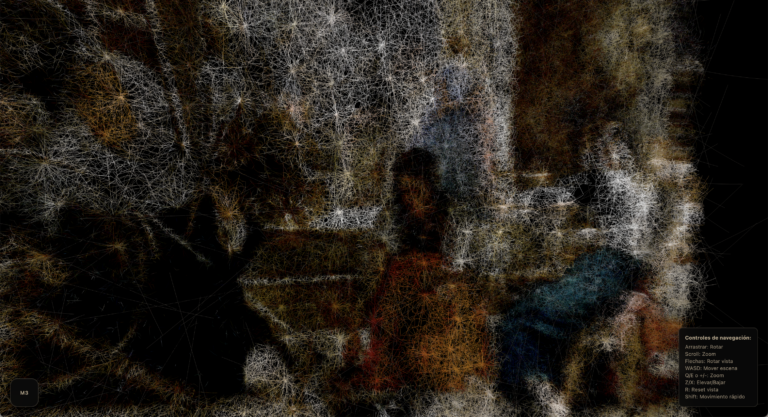
An image becomes a three-dimensional space and responds to hand movements in real-time.
Depth Cloud is an audiovisual experimentation prototype developed in the Artefacto Films laboratory that transforms still images into interactive three-dimensional point clouds. The project arises as an aesthetic exploration within a broader research on spatial perception in cinema and the question of what happens when a photograph or a film frame acquires depth, volume, and the capacity for physical response. The image stops being a flat surface and becomes navigable matter, a structure that the body can manipulate with its hands in front of a screen.

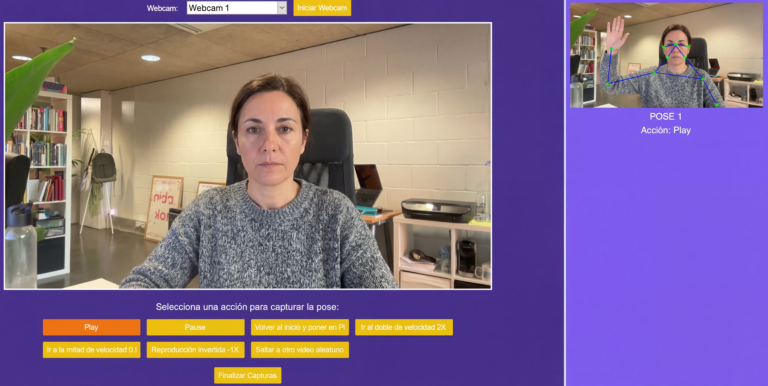
The system works in three linked stages. In the first, the user uploads an image and Google’s Gemini multimodal language model generates a depth map—a grayscale representation where each pixel value encodes the estimated distance to the camera plane. In the second stage, a conversion process transforms that map into a three-dimensional point cloud rendered in real-time using WebGL shaders within a React component. In the third, MediaPipe Hands analyzes the user’s camera signal and translates hand gestures into spatial transformations on the cloud, rotation, scale, explosive particle dispersion. The system also operates in an alternative mode where Gemini Nano generates voxelized scenes from the same input image, producing a discrete volumetric representation of the photographic space.

For more than a century, cinema organized the gaze from a fixed point: the immobile spectator in front of a flat projection. Depth Cloud subjects that convention to direct tension. By converting the frame into a point cloud manipulable with the body, the project proposes that the cinematographic image has a latent spatiality that computer vision models can make visible. At the same time, it opens a reflection on the nature of depth generated by artificial intelligence; the depth estimation produced by Gemini is a statistical inference, an interpretation of space that the model builds from patterns learned in millions of images.

The prototype allows exploring how a single tool can be simultaneously an instrument for film archive analysis, an interactive installation device, and a platform for aesthetic experimentation with point clouds.